From a first room and a merchant feed to a complete, reviewed 3D collection. The experiments, decisions and refinements behind the configurator.
22 October – 20 November 2026
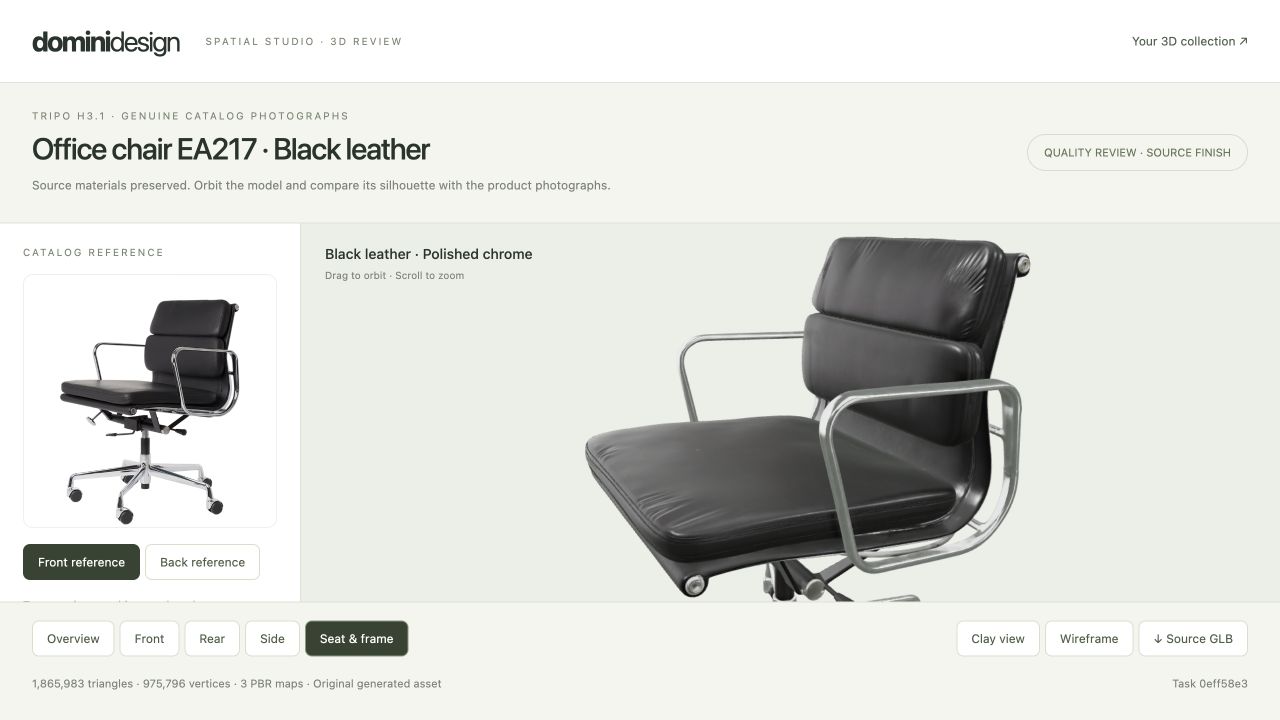
A new quality referenceTripo H3.1 · EA217 pilot review
169Reviewed furniture & lighting designs
859Catalog finishes in 3D
33Accessory variants excluded
0Project inference runtimes retained
History documented through 20 November 2026Current build · last verified cleanup: 7 November
25 milestones · 6 chapters
No matching milestones.
Try another phrase or clear the filters to see the full development history.
01
22 October · 2026
The first room
The brief, the real catalog and a working space to design in.
StudioFoundation
A professional interior studio, built around real furniture
The project began with a clear brief: create a polished 3D room configurator for DominiDesign products, with furniture placement and catalog-based customization.
Changes and outcome: A professional interior studio, built around real furniture
Established dominidesign.com as the product source and adopted the brand’s restrained, warm visual direction.
Defined the core journey: create your space, make it yours, and review your collection.
Set the quality target around recognizable product geometry, convincing materials and a professional browser interface.
Outcome. A product configurator and room-planning workflow became the central deliverable.
StudioImplemented
The first interactive room
The studio gained its Three.js scene, architectural shell, lighting and furniture controls.
Changes and outcome: The first interactive room
Added room dimensions, floor and wall finishes, orbit and zoom, a floor-plan view and furniture placement.
Built selection, rotation, duplication, removal, size and height controls, plus undo and redo.
Added local project saving, project JSON import/export, scene image export and GLB import support. These controls were refined during later catalog integration.
Outcome. Users could create and revisit a furnished space in the local browser.
GOOGLE_MERCHANT_UK.xml supplied the actual product catalog, photographs, variations and commercial information.
Changes and outcome: The merchant feed replaced the sample collection
Imported 892 feed entries and grouped related finishes into product families.
Connected catalog names, source images, designers, materials, prices, stock and product links to the interface.
Added catalog search, category filters, sorting, finish swatches and exact-variation selection. The feed’s EUR prices were retained.
Outcome. The studio became a configurator for the supplied collection, rather than a generic furniture demo.
02
22–24 October · 2026
Finding the right geometry
Local and hosted experiments, quality failures and the limits of single-image reconstruction.
AI trialsRetired
The first image-to-3D catalog pass exposed quality problems
The initial TripoSR-based draft conversion covered the early catalog grouping, but the room views revealed broken silhouettes, missing thin parts and rough surfaces.
Changes and outcome: The first image-to-3D catalog pass exposed quality problems
Generated draft assets from catalog photographs and provided source/result inspection pages.
User reviews identified damaged chair shells, fragmented legs and frames, and visible reconstruction artifacts.
Separated conversion coverage from approval: a completed generation counter did not mean the model was suitable for the configurator.
Outcome. The first draft library did not meet the required visual standard and was later removed.
QualityDecision
Clean previews stayed the default while AI drafts were inspected
The user chose to keep clean room previews and inspect experimental AI results on demand.
Changes and outcome: Clean previews stayed the default while AI drafts were inspected
Introduced explicit model modes and source-finish labels so a trial would not silently replace the furniture in a room.
Added draft downloads and comparison controls for reviewing an exact asset.
Addressed repeated local-preview interruptions and documented the loopback studio service and launch command.
Outcome. Geometry experiments could continue without treating every draft as a finished catalog asset.
AI trialsRetired
Hunyuan3D trials improved shapes, but materials needed intervention
Hunyuan3D-2.1 and a community Mac workflow were tested, with attention narrowed to representative chairs and the first four requested products.
Changes and outcome: Hunyuan3D trials improved shapes, but materials needed intervention
Investigated local Apple Silicon inference, the generation queue and browser integration.
Reviewed missing shell regions, noisy chrome and color leakage between plastic, wood and metal.
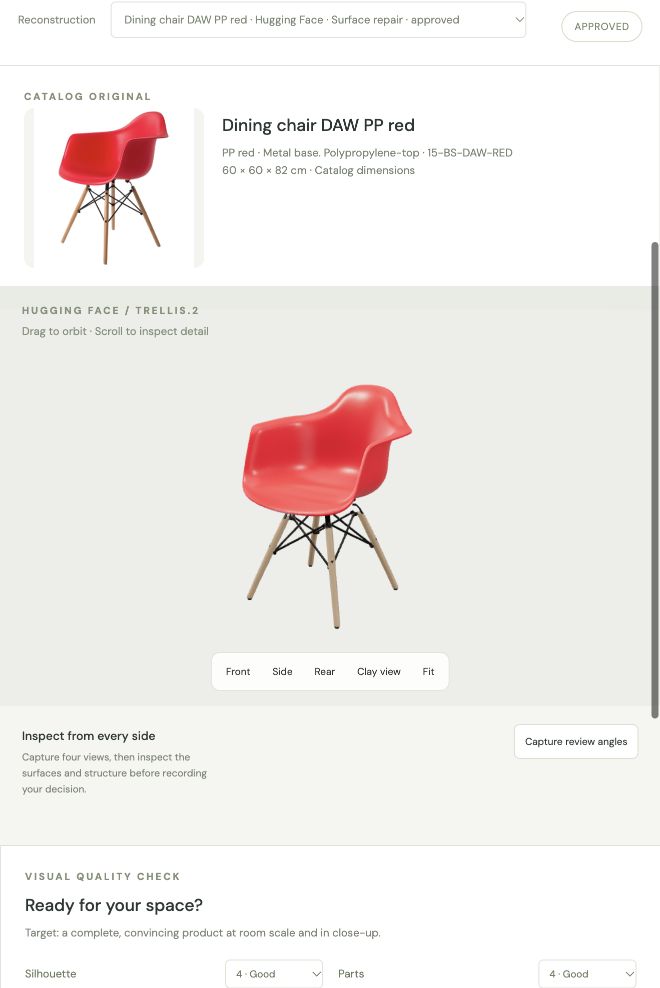
Applied selective material and surface adjustments; the repaired red DAW chair showed that separating finish regions could improve a usable shape.
Outcome. Some trials improved after material repair, but this engine did not become the final catalog library.
AI trialsRetired
TRELLIS.2 was brought into the Mac testing workflow
The official TRELLIS.2 project and community Apple Silicon ports were investigated and a local manual-generation interface was made available.
Changes and outcome: TRELLIS.2 was brought into the Mac testing workflow
Worked through gated conditioning/background-removal downloads and local dependency setup.
Tracked download progress, generation stages, process status and integration with the studio’s inspection flow.
Investigated Metal watchdog failures that could leave an empty decoded mesh, keeping runtime success separate from usable output.
Outcome. TRELLIS.2 produced inspectable trials, but device reliability and surface quality still required manual attention.
QualityHistorical workflow
Local and Hugging Face candidates received an explicit review gate
A generation and quality library recorded candidate provenance, settings and inspection decisions, rather than approving results from a completion signal alone.
Changes and outcome: Local and Hugging Face candidates received an explicit review gate
Compared catalog photographs with front, side, rear and clay views of generated candidates.
Recorded quality decisions for silhouette, parts, materials, texture, scale and rendering on the exact asset.
A repaired Hugging Face TRELLIS DAW candidate was accepted for its source finish at that stage. Bounded periodic checks were approved, and later batch activity was stopped at the user’s request.
Outcome. The review process established useful acceptance checks. Its old candidates and review pages were retired when the current Tripo-only library was finalized.
Historical candidate review. This earlier approved trial is no longer part of the active collection.
AI trialsRetired
SAM 3D Objects was tested with an offline Mac path
SAM 3D Objects was evaluated through a community Mac port, including a requested run without a Hugging Face API or cloud GPU.
Changes and outcome: SAM 3D Objects was tested with an offline Mac path
Investigated checkpoint access and separated model downloads from offline inference using local checkpoints.
Added diagnostics around PyTorch3D camera transforms, fp16/fp32 boundaries and MPS execution.
Investigated empty mesh export after Metal errors and moved dense surface construction to CPU while retaining neural decoding on Metal in the trial path.
Outcome. Runtime, camera and mesh-export checks were documented separately from visual quality. SAM did not become the production catalog engine.
MaterialsRetired trial
An acceptable office-chair shape led to texture and mesh repair
A manually generated TRELLIS office chair had a recognizable shape, but its leather and chrome surfaces remained noisy.
Changes and outcome: An acceptable office-chair shape led to texture and mesh repair
Created texture-review and mesh-review comparisons for the EA117-style chair.
Worked on material separation, leather and chrome response, surface normals, seat defects and mesh cleanup.
Attempted additional repair of holes in the thin chrome frame; these experiments remained distinct from the later Tripo assets.
Outcome. Repair clarified how much geometry and material work a single-image output could still require. The repaired trial was eventually superseded.
AI trialsRetired
Previous local engines were removed; Hunyuan3D-2mv was tried
At the user’s request, the earlier inference installations were removed before a multiview Hunyuan3D-2mv trial.
Changes and outcome: Previous local engines were removed; Hunyuan3D-2mv was tried
Recorded a new multiview geometry trial and its source views.
Made the initial untextured result explicit, then added material/texturing inspection rather than presenting a geometry-only export as complete.
Kept the trial separate from accepted catalog models. Its remaining installation was removed in the later cleanup.
Outcome. The multiview trial remained a research result; none of its models ship in the current configurator.
03
24 October–3 November · 2026
Building the Tripo collection
A new quality reference, genuine product views and reviewed catalog finishes.
TripoAdopted
User-supplied Tripo models set a new quality reference
The imported black office chair and lounge-chair/ottoman models demonstrated the finish quality the user wanted in the room.
Changes and outcome: User-supplied Tripo models set a new quality reference
Decoded Meshopt-compressed GLBs into editable exports while retaining PBR materials.
Tested import, scale changes and material-editing options in the configurator.
Adopted the supplied Tripo result as the reference for subsequent catalog production. Later sizing replaced the temporary doubled-size export with calibrated models.
Outcome. Production moved toward reviewed Tripo H3.1 geometry instead of further local-engine catalog conversion.
TripoIntegrated
Studio generation and the official CLI joined the workflow
The existing upgraded Tripo account was used through the browser, with the official CLI/API workflow added for a pilot batch.
Changes and outcome: Studio generation and the official CLI joined the workflow
Connected the local CLI through Tripo’s authorization flow and checked the separate API credit pool before generation.
Used the explicitly approved free API-credit benefit for reviewed pilot work, then continued the remaining catalog through the Studio browser as requested.
Kept H3.1 quality and prioritized distinct designs within the approved existing-credit budgets. No additional purchases were enabled.
Outcome. Generation had an authorized account workflow and a clear distinction between Studio and API capacity.
CatalogDecision
169 designs, all their finishes, and genuine product views
The scope was clarified: a master model for each distinct furniture or lighting design, plus its catalog finishes. Accessories were excluded.
Changes and outcome: 169 designs, all their finishes, and genuine product views
Reduced the supplied 892 entries to 859 included finish SKUs across 169 families, excluding 33 accessory variants.
Collected product galleries and inspected matching front, rear and side views before multiview use.
Left missing views unfilled; not every product had a genuine multiview set. The retained catalog status records 14 reviewed matching sets.
Outcome. The family count represented geometry designs, not the number of individual finish exports.
Targeted repairs addressed the remaining product-specific defects
The accepted collection was refined where generated material boundaries or individual components still looked wrong.
Changes and outcome: Targeted repairs addressed the remaining product-specific defects
Applied targeted surface and material-region repairs instead of recoloring whole products indiscriminately.
Worked on transparent/glass components, mesh and netweave, globe and pendant parts, wood regions, small holes and disconnected components.
Retained browser evidence and marked representative natural grain or reconstructed details where appropriate.
Outcome. The current models preserve the reviewed repairs; historical before/after source exports were later removed.
MaterialsCompleted
The finish library reached 859 of 859
Reviewed master geometry was extended into SKU-specific PBR finishes, with further material checks and refinements following the completion record.
Changes and outcome: The finish library reached 859 of 859
Separated material regions so upholstery, shells, wood, frames and metal could follow the correct catalog option.
Added finish colors, leather/fabric behavior, representative wood grain and veining, and exact-SKU GLB exports.
Recorded that these are material variants of reviewed Tripo geometry, not 859 independent image-to-3D generations. Three PH50 placeholder photographs are handled through their named catalog colors and flagged in the registry.
Outcome. All 859 included finishes became selectable and downloadable. The completion snapshot is recorded on 31 October, with subsequent refinements retained in the current assets.
Real product measurements, calibrated exports and saved-room compatibility.
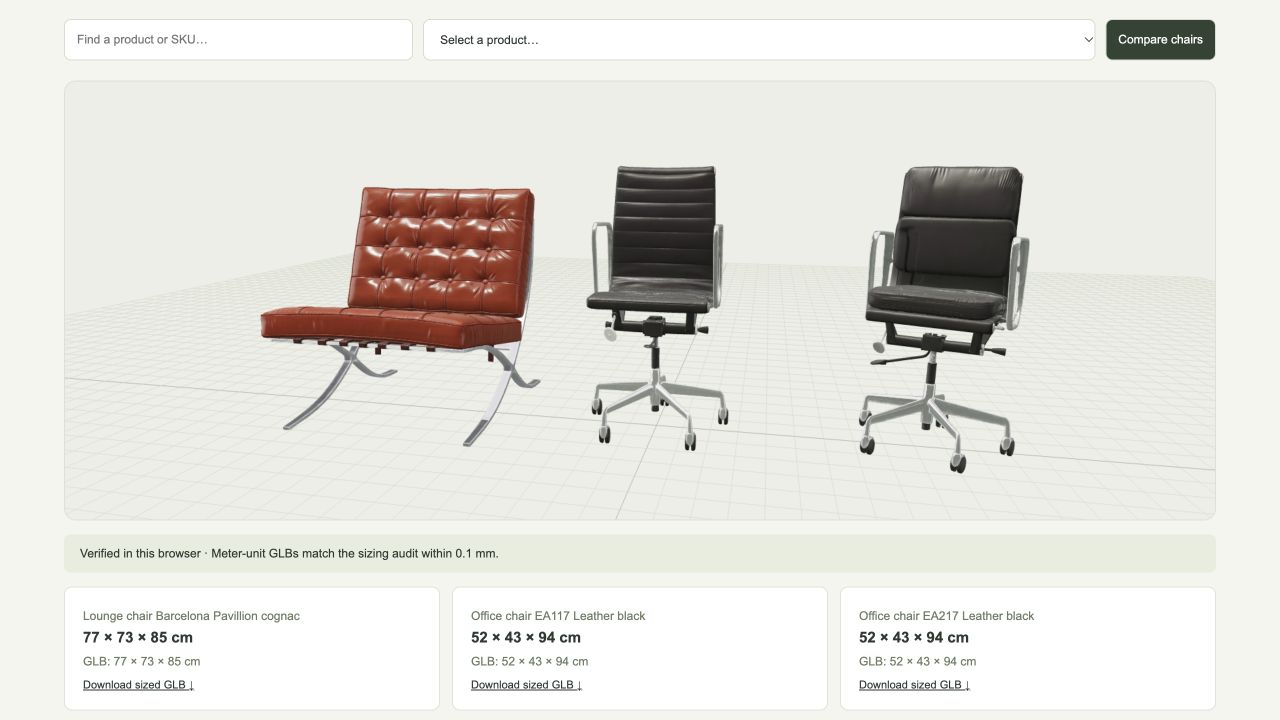
Sizing verification · The browser comparison checks exported dimensions, not manufacturing tolerances.
DimensionsVerified
Every model was calibrated to product dimensions
A collection-wide sizing audit checked official product specifications and drawings after the user identified inconsistent chair sizes.
Changes and outcome: Every model was calibrated to product dimensions
Corrected width/depth orientation before sizing and exported all 859 GLBs in meters.
Sized chair and ottoman components independently, separated pendant shade dimensions from the visible suspension, and used the maximum catalog height for adjustable furniture.
Documented conflicting product measurements and two inferred dimensions: the Toledo floor-lamp depth and the overall height of the 75 cm Navy bar stool.
Outcome. All 859 decoded exports passed the 0.1 mm digital bounds tolerance. This checks the file dimensions; it does not certify AI geometry or manufacturing accuracy.
The dimension corrections were applied throughout the application, not only in an inspection viewer.
Changes and outcome: Corrected sizes reached saved rooms and downloads
Updated the model registry, collection links and both downloadable GLB collections to the calibrated exports.
Preserved saved room positions, world-facing directions, custom product sizes and placement heights during migration.
Verified representative chair comparisons, finish switching and a downloaded EA217 export against the published asset. Office-chair EA117 and EA217 stock exports use the chosen 52 × 43 × 94 cm catalog size.
Outcome. The studio and its downloadable files used the same corrected dimensions and retained PBR textures and UV data.
05
6–9 November · 2026
A considered final library
Removing retired engines and redundant assets, then preserving the development record.
MaintenanceRemoved
The remaining local inference installation was removed
The remaining Hunyuan3D-2mv checkpoint, isolated runtime, vendor checkout and project-specific helper caches were deleted at the user’s request.
Changes and outcome: The remaining local inference installation was removed
Removed approximately 6.6 GB of allocated project inference storage and helper caches.
Kept all current Tripo exports and their textures; unrelated pre-existing environments and credentials were left untouched.
Disabled local generation endpoints and kept the previously paused quality-check automation inactive.
Outcome. The configurator no longer depended on a local image-to-3D model installation.
MaintenanceCompleted
Redundant finish files and build templates were removed
A reference audit identified superseded unscaled finishes, duplicate paths, material-build templates and unused intermediates in the oversized model folder.
Changes and outcome: Redundant finish files and build templates were removed
Updated the finish-review page to load and download the current calibrated GLBs directly.
Removed 1,751 obsolete file paths while protecting all active model files and linked download collections.
Reduced the model folder from about 108 GB to 54 GB and recovered about 22 GB of physical disk space; shared APFS storage explains the difference between file-size reduction and recovered space.
Outcome. All 859 current finishes, model URLs and representative download hashes remained unchanged.
MaintenanceCurrent baseline
Only the current Tripo model collection remained
The final cleanup removed the remaining TRELLIS, Hunyuan, SAM and TripoSR drafts, older Tripo source exports and archived trial binaries.
Changes and outcome: Only the current Tripo model collection remained
Kept exactly 859 active Tripo GLBs with embedded PBR textures, current reference photos, preview images and the two hard-linked download collections.
Retired old review entries and redirected their pages to the current collection. Removed legacy worker imports so the server could not republish deleted candidates.
Verified every model URL, checked representative download hashes, tested saved-draft migration and confirmed the room still rendered. The model folder settled at about 45.2 GB, with about 25 GB more disk space recovered in this pass.
Outcome. No project inference weights or retired model binaries remained. Existing saved AI draft products now resolve to their current Tripo finish where available.
StudioAdded
The development history became part of the configurator
This page brings the project’s major decisions, experiments, quality reviews and final implementation into one accessible development log.
Changes and outcome: The development history became part of the configurator
Added dated chapters, searchable milestones, category filters and a concise view of the current build.
Linked the history from the studio and 3D collection, with routes back to live model and dimension reviews.
Preserved a small selection of historical screenshots and sanitized evidence summaries without restoring removed models or account credentials.
Outcome. The development record can now be read from inside the configurator.
QualityVerified
Glass tabletops were rebuilt as continuous closed surfaces
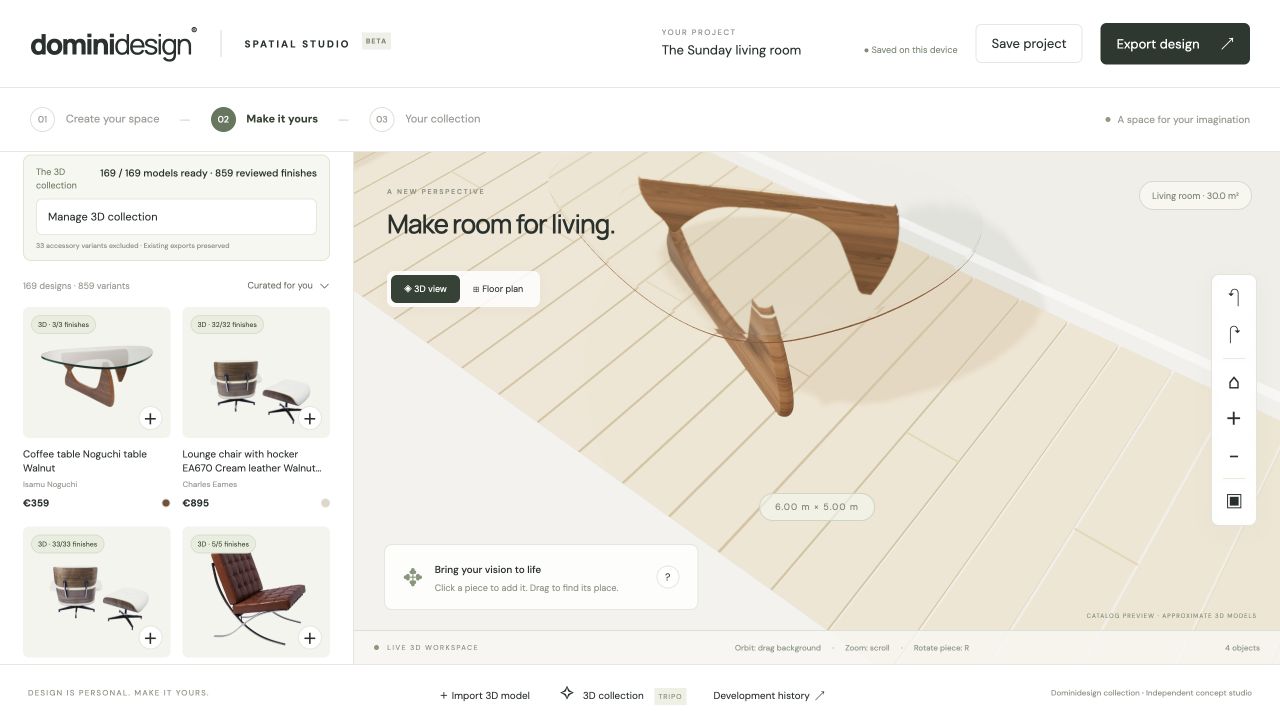
A user screenshot revealed a large opening in the Noguchi tabletop. A geometry audit then checked all 15 current glass-table variants.
Changes and outcome: Glass tabletops were rebuilt as continuous closed surfaces
Rebuilt the three Noguchi finishes as closed, beveled plates using the retained 18 mm catalog specification; also repaired small gaps in the E1027 glass.
Verified complete sampled tabletop coverage, closed manifold geometry and unchanged catalog dimensions. Original base geometry, frame materials and texture bytes were retained.
Updated the configurator, review pages and downloadable GLBs. Tested the Noguchi finishes in the actual room, restored the original room contents, and removed superseded model files.
Outcome. All 15 glass-table variants passed the coverage recheck; the collection remains 859 current Tripo finishes.
In-room verification · A complete glass plate replaces the earlier central opening.
06
20 November · 2026
From studio to production
Publishing the reviewed collection as a compact static website, while retaining its original model quality.
StudioPublished
A compact production release went live
The complete reviewed collection was published at studio.dominidesign.com with HTTPS and a static hosting architecture.
Changes and outcome: A compact production release went live
Packed the current 169 designs and 859 catalog finishes into an approximately 8.2 GB release, reducing the original model footprint by about 82% through shared resources and lossless compression.
Verified that every active scene retains its original geometry, PBR image bytes, material declarations and calibrated transforms. Downloadable GLBs are assembled from the same resources when requested.
Checked browser placement, finish changes, dimensions, responsive layouts and real GLB exports; verified every server file by SHA-256 before activation.
Outcome. The complete collection is available online with its product dimensions, finish selection, review pages and development journal.
This journal brings together the development conversation, retained project notes, quality screenshots, catalog registries and verification reports. Dates shown as ranges group related work. It records the major milestones, rather than every command or message.
Historical trials are labeled as retired. Their screenshots remain a visual record; their model files and local inference installations have been removed. The current collection uses Tripo geometry, and its 859 finishes are material variants rather than 859 separate AI generations.
Natural grain, veining and reconstructed hidden details remain approximate. The 0.1 mm sizing check concerns the digital export bounds, not furniture manufacturing or CAD accuracy.